
U.S. news
As the pandemic eliminated more than a half-million Americans, it likewise silently inflamed another public health crisis: addiction.

Larrecsa Cox peers around a stairwell while strolling through a deserted house in Huntington, W.Va., on March 18.
Cox leads a group whose objective is to find every overdose survivor to save them from the next one.
Huntington was when ground zero for the addiction epidemic, and several years ago they formed the Quick Action Team. It was a hard-fought fight, but it worked. The county’s overdose rate plummeted.
Then the pandemic shown up and it reversed much of their effort.
— David Goldman/ AP

Cox demonstrates how to administer the overdose reversal medication naloxone in Branchland on March 15.
The Centers for Illness Control and Prevention approximates that more than 88,000 people died of drug overdoses in the 12 months ending in August 2020– the latest figures available. That is the highest variety of overdose deaths ever recorded in a year.
” People I’ve understood all my life considering that I was born, it takes both hands to count them,” she stated. “In the last six months, they’re gone.”
— David Goldman/ AP

Yvonne Ash carries a CPR package and a supply of naloxone back to her house after a visit from the Quick Response team in Branchland.
The group provided Ash with a package on how to administer the medication, simply days after her son had overdosed.
” We need help,” Ash said.
— David Goldman/ AP

Yvonne Ash’s kid Steven, 33, working at the tire store on March 17 where he overdosed just days prior to in Huntington.
When Ash overdosed, he dropped among the stacks of utilized tires behind the shop his family has owned for generations. His mom, pleading, weeping, had thrown water on him since she couldn’t think of anything else to do.
— David Goldman/ AP

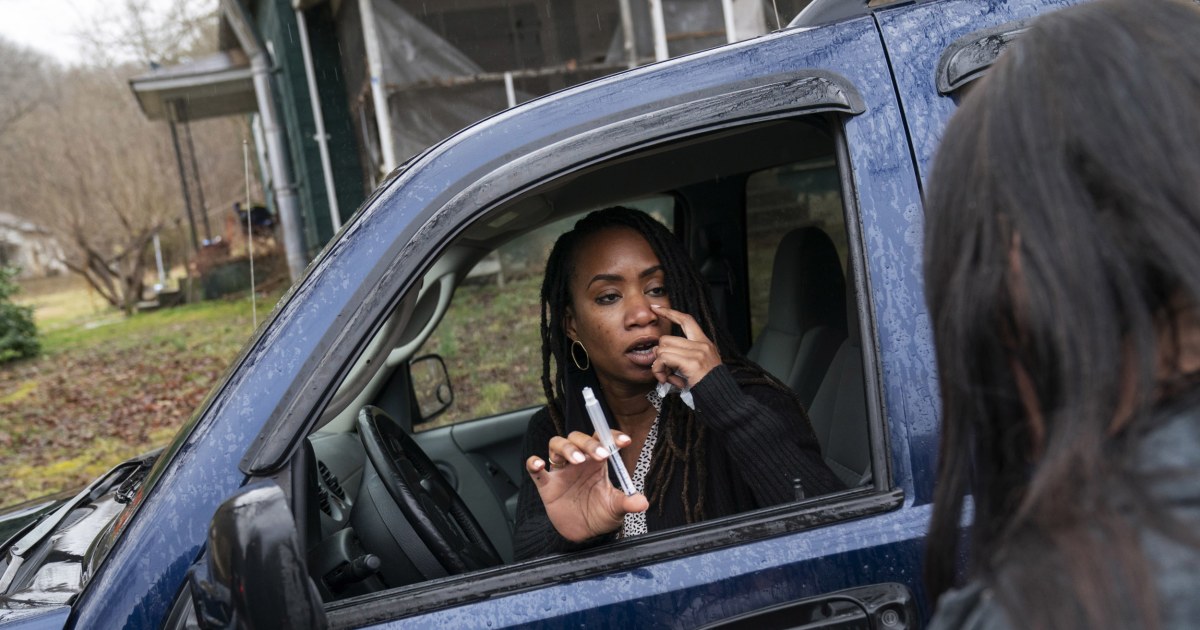
Cox sits in her car with a list of individuals to visit after offering a man a supply of naloxone on the street in Huntington.
— David Goldman/ AP

Cox has a calm disposition, with dreadlocks down to her waist.
” You’re not in difficulty,” she constantly says initially, then offers them naloxone.
She wants her clients to be straight with her so she’s straight with them. “Everyone here is believing that you’re going to go get high and not return,” she’ll say, their weeping households nodding their heads.
— David Goldman/ AP

Joshua Messer, 29, sits in his aunt’s home in Huntington, where he’s currently remaining, days after he overdosed.
— David Goldman/ AP

Messer was a high school basketball star, heading to college on a scholarship. He still boasts that he was such a star professional athlete he when satisfied the governor. But dependency took hold.
— David Goldman/ AP

The message “RIP Debo” is spray-painted on the apartment door that had actually been the home of 41- year-old Debbie Barnette, a mother of 3, in Huntington.
Barnette had dealt with dependency all her life. She overdosed often times and established infections. By the time she looked for treatment, the infection in her heart was too far gone.
— David Goldman/ AP

Sue Howland, a member of the Quick Reaction Team, checks in on Betty Thompson, 65, who battles with alcoholism, at her apartment in Huntington.
It had actually been days because Thompson had eaten or taken her medications. Cox combed through her bottles of tablets and arranged them into a pill organizer. They arranged a consultation with her medical professional the next day. They contacted us to have actually a sandwich delivered. Cox evacuated her trash to haul out to the dumpster.
— David Goldman/ AP

A banner with a picture of Jesus hangs outside a home as a mail provider strolls down the street in Huntington on March 17.
The Quick Action Team was born in the middle of a dreadful crescendo of America’s dependency epidemic: On the afternoon of Aug. 15, 2016, in simply four hours, 28 individuals overdosed in Huntington. By 2017, the county had an average of six overdoses a day. Paramedics burnt out of reviving the same individuals once again and again.
— David Goldman/ AP

Misti Mann-France stands in a bathroom at the laundromat she handles in Huntington under a blue light set up to make it harder for drug users to discover a vein.
— David Goldman/ AP

Jeff and Lola Carter stand with their child, Amanda, and a framed picture of Kayla, their child who had problem with drug addiction, at their house in Milton.
Kayla Carter was hospitalized last summer season with endocarditis, a heart infection from utilizing unclean needles. Her moms and dads stood at her bedside and thought she looked 100 years old. She remained off drugs when she got out of the medical facility. She said she was sorry for all she ‘d missed out on: children born, birthday celebrations, funeral services. They believed they had her back.
Then she stopped addressing calls. Her mom went to her house on a Friday early morning in October and discovered her dead on her restroom floor.
— David Goldman/ AP

An authorities patrol lorry sits along a stretch of railway tracks in Huntington on March 17.
Huntington was when a growing commercial town of almost 100,000 individuals. It sits at the corner of West Virginia, Kentucky and Ohio, and the railway tracks through town used to rumble all day from trains loaded with coal. Then the coal industry collapsed, and the trains don’t come so much any longer.
— David Goldman/ AP

Cox talks with paramedics at an overdose call in Huntington.
This beleaguered city used a glimmer of want to a country impotent to include its decades-long dependency disaster. The federal government honored Huntington as a model city. They won awards. Other locations came to study their success.
The very first couple months of the pandemic were quiet. Then came May. The 911 calls begun and seemed like they would not stop– 142 in a single month, nearly as many as in the worst of their crisis.
— David Goldman/ AP

Sue Howland, left, and Sarah Kelly hug after Howland provided her with a coin marking Kelly’s one-year anniversary in recovery, outside her home in Guyandotte on March 17.
After having problem with opioid addiction the majority of her life, 37- year-old Sarah Kelly white-knuckled her method through the pandemic. Then she browsed courts to get custody of her kids back after more than 2 years apart.
— David Goldman/ AP

” I understood there was this version of me still in there someplace, and I understood that if I got up every day and actually decided to stay sober, I might get to be her again,” Kelly stated. “I could look in the mirror and be proud of who I was, and my children could be happy with me.”
They cohabit now in a little house on the borders of town.
— Reporting by Claire Galofaro/ AP
— David Goldman/ AP


No comments:
Post a Comment